FORCE AS MESSAGE

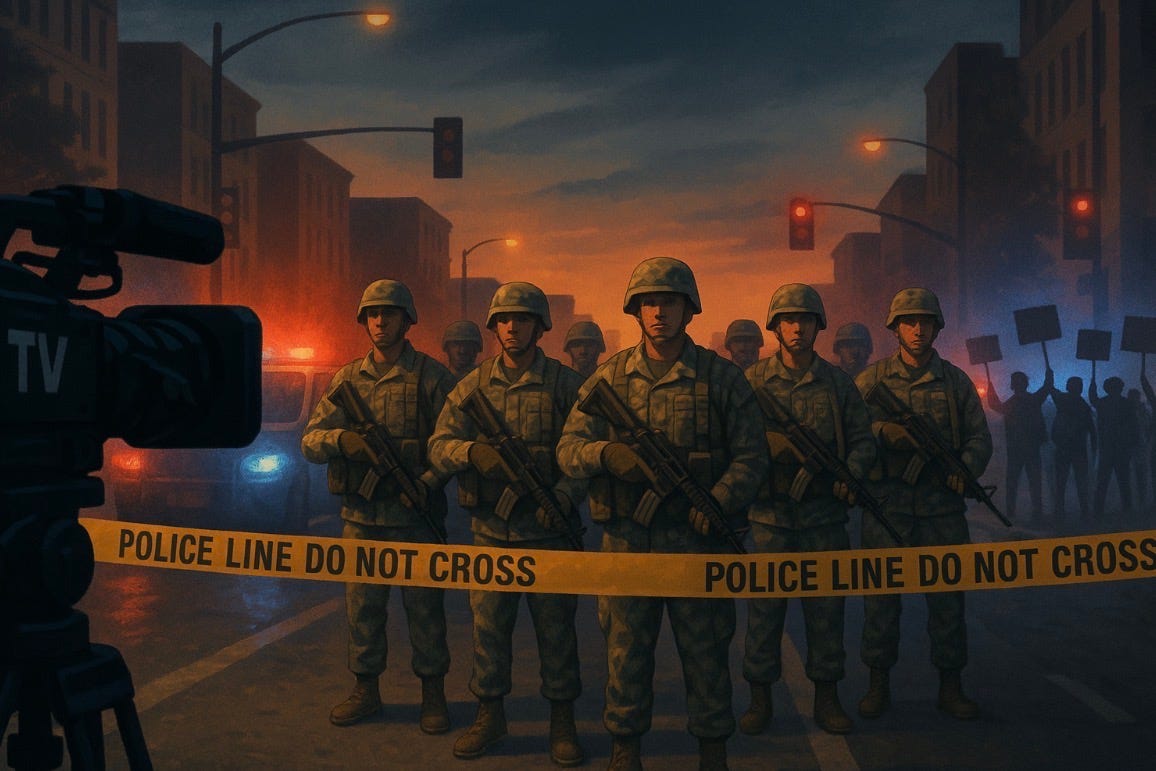
Who Controls the Troops on Our Streets?
Here’s a question we weren’t all asking ten years ago, but we’re absolutely living inside now:
Who gets to put troops in America’s streets — and who gets to control the story when they do?
This is no longer a law textbook question. It’s a messaging strategy.
In June 2025, the White House claimed that protesters were preventing federal agents from enforcing immigration law. On that basis, the President moved to take command of state National Guard troops — and sent thousands of them, plus Marines, into Los Angeles.
Not for a hurricane.
Not for an earthquake.
For “law and order.”
That was followed by threats (and in some cases attempts) to send Guard units into Chicago, Portland, San Francisco and other cities, with the President presenting himself as the one adult in the room: If local leaders “won’t keep you safe,” I will.
This is the new move:
Declare a local situation a national emergency.
Deploy troops or threaten to.
Film it.
Run on it.
It’s not just force. It’s content.
—
Wait — can a president really do that?
Usually, the National Guard answers to governors. The Guard is what shows up for floods, fires, tornadoes, ice storms — all the awful things that hit regular people in real places. That “my governor sent help” identity matters, politically and emotionally.
But there’s a pressure switch in federal law.
Under certain conditions, the President can “federalize” a state’s National Guard. Once that happens, those troops stop answering to the governor and start answering to the White House — basically becoming active-duty military.
The original idea was: use this in extreme situations.
• Invasion.
• Open rebellion.
• When normal law enforcement has truly broken down.
Now zoom in on that last part: “when normal law enforcement can’t do the job.”
Who decides when that line has been crossed?
Answer: Whoever controls the microphone.
If you say a protest of 200 people outside a migrant intake center is “rebellion,” then you can argue that normal policing “can’t” handle it, therefore you “have” to send troops. The legality of that is being hammered out in court right now. But the visual — soldiers in American streets — already aired on the nightly news.
By the time a judge says “this is illegal,” the clip is in the campaign ad.
That’s not a bug. That’s the design.
—
The legal fight is actually a story fight
Governors in places like California and Illinois pushed back hard. They argued: this is political theater, not public safety. In Chicago, a federal appeals judge temporarily blocked an attempted deployment and wrote that there was “no credible evidence” of anything close to rebellion.
Translation: Stop pretending a protest is a civil war.
The White House position, meanwhile, is: local officials are weak, I’m stepping in because they won’t.
Translation: I am the protector. They are the chaos.
That is the messaging war. Both sides are fighting to define the same streets.
Whose frame sticks — “the city is out of control” vs. “the president is grabbing power he shouldn’t have” — determines who looks like leadership.
This is why we can’t keep treating troop deployments as if they’re neutral emergency responses. They are now campaign language with rifles.
—
The loophole you’re not supposed to notice
There’s also a gray-zone status called “Title 32.”
In Title 32 status, Guard troops can be funded and tasked by the federal government, but technically they still report to the governor. On paper, that sounds boring. In practice, it’s brilliant politics.
Why?
Because afterward, both the governor and the president can claim credit:
• “We acted fast to keep people safe.”
• “No, I acted fast to keep people safe.”
And if something goes wrong (injuries, escalation, bad footage), each side points at the other: “They were in charge.”
That ambiguity is useful. Ambiguity lets you cut your version of the ad.
—
Washington, D.C. is the test market
The President doesn’t even have to ask permission in Washington, D.C. The D.C. National Guard reports directly to the White House. So when Guard troops were sent into D.C. “to fight crime” — even as crime was reportedly trending down — it wasn’t just policing. It was a billboard.
Message: “See? I can do this. I can send troops to stop violence. I don’t have to wait for anybody.”
Other cities were meant to absorb that message.
You weren’t just watching patrols.
You were watching a proof-of-concept.
—
Why this matters (and why it’s bigger than one president)
If we normalize the idea that any president can:
• Declare your block an “emergency zone,”
• Override your governor,
• Drop troops in helmets and tactical gear,
• And then run for reelection on the footage,
…then we’ve quietly changed who governs public space in America.
We’ve also created a script that every future president — of either party — can reuse.
That should bother you even if you love the current administration. Especially if you love the current administration. Because scripts, once written, get handed to people you don’t love.
We are watching the merger of three things:
Policing.
Campaign messaging.
Constitutional gray area.
That merger is what I call the messaging state.
In the messaging state, “security” is not only about keeping you safe. It’s about convincing you who keeps you safe — and convincing you that anyone who says otherwise is on the side of chaos.
That’s the real battlefield now:
Not just the street in front of City Hall.
The story about that street.